















ANTONIS REMOS -Live Experience Tour 2020 with DiGiCo and Klang equipment
By Vasilis Ladonikolas, www.alive.gr
Antonis Remos is the leading Greek performer of his generation, having managed to remain firmly at the top of the mainstream Greek music scene over the years.
This year, after another successful season at the Pili A of Thessaloniki, which ended in late January, Antonis Remos was decided to tour nine major cities in Greece, with the Live Experience Tour 2020 starting in Athens at the Faliro Olympic Indoor Hall (Tae Kwon Do).
State of the art - Audio equipment
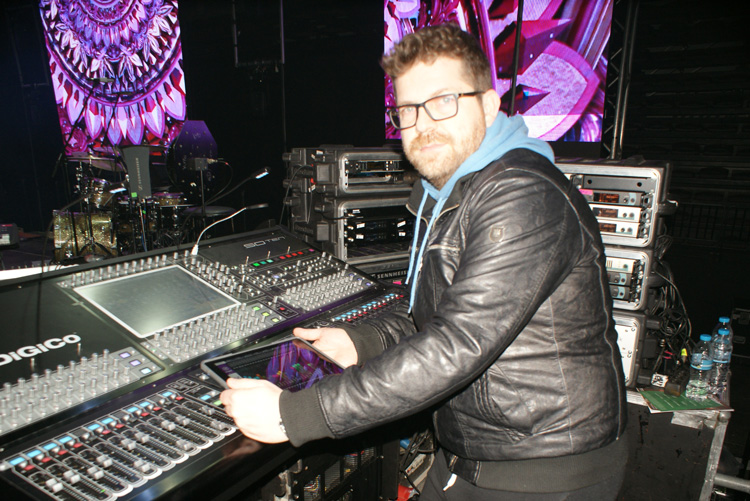
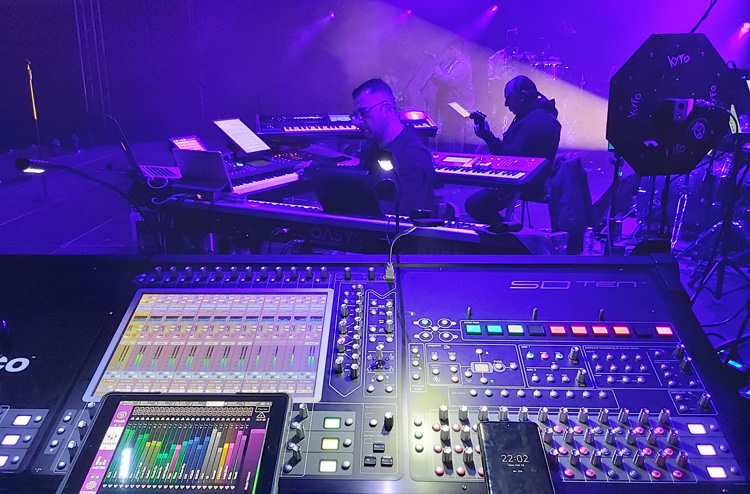
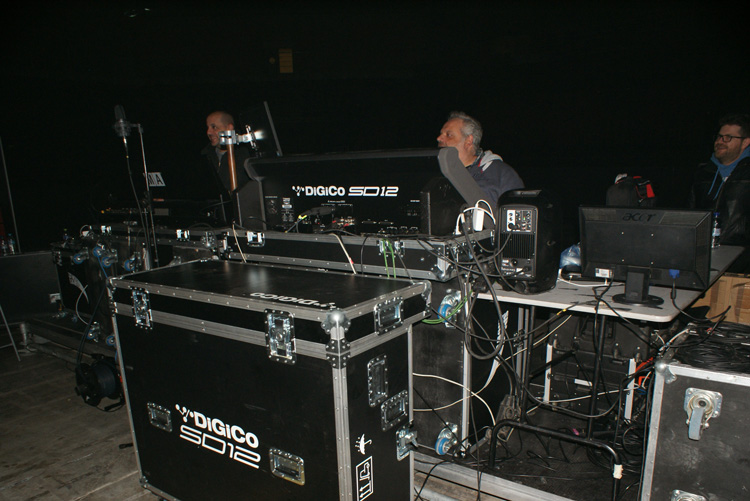
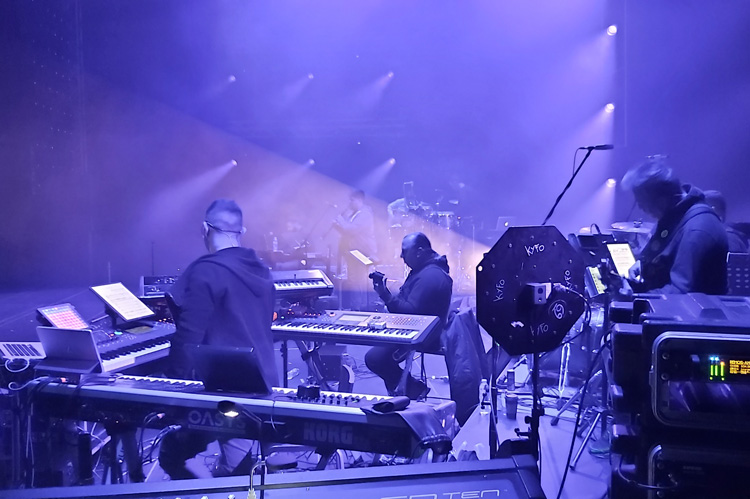
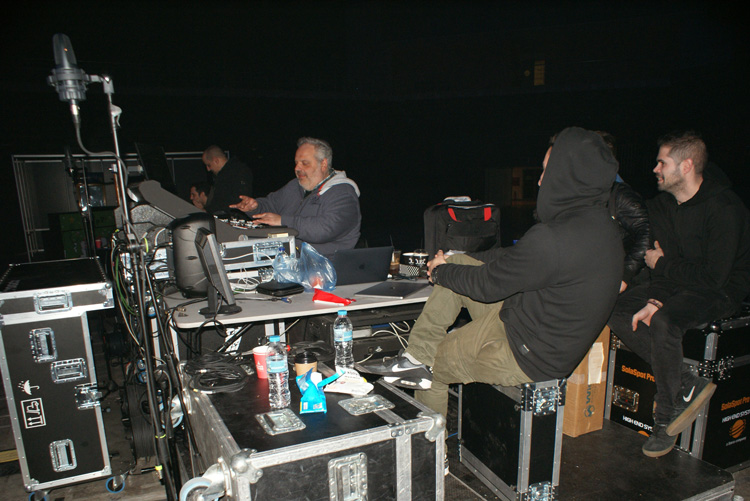
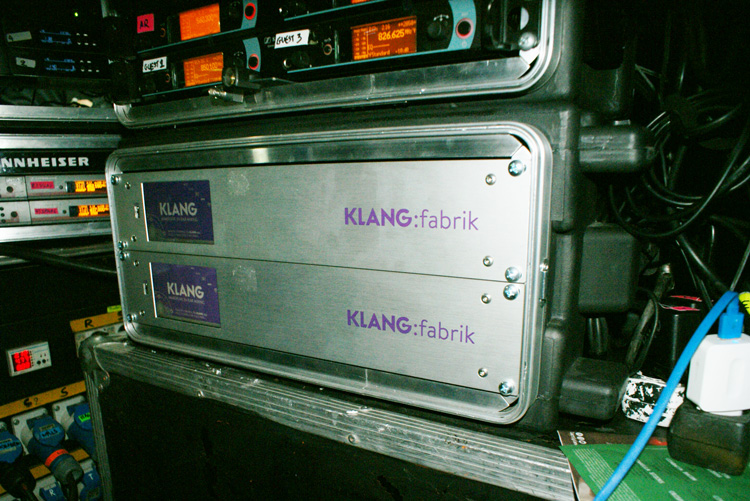
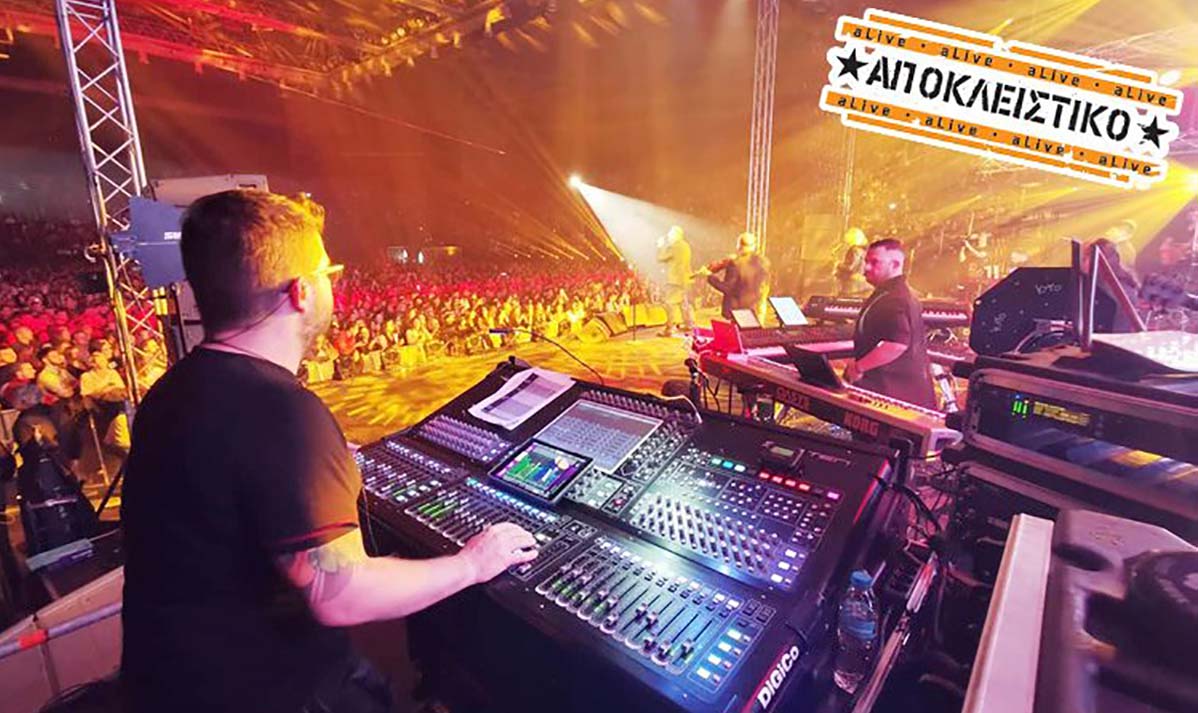
ALive after meeting with George Panolaskos and Aris Kountouris, friends and fellow sound engineers of Antonis Remos, went to Tae Kwo Do at the rehearsal two days before the concert on February 12. The main reason we went to A. Remοs's concert was to present the Klang 3D in-ear system on the monitors, the two brand new DiGiCo consoles (SD12 on Foh and SD10 on monitors) with two 192kHz SD and Rack the full 32-bit 'Stadius' pre-amps owned by Papadimas Audio, as well as the entire L-Acoustics audio system, support system, lights and LED screens. After all, Papadimas Audio is the company that will follow and support Antonis Remos at all Greek stations of the Live Experience Tour 2020 (in Patras, Larissa, Chania, Heraklion, Xanthi, Volos, Kozani and Thessaloniki).
As we said, the PA system installed here at TAE KWON DO consists of 12 K2 L-Acoustics per side along with 8 + 8 dV-DOSC as LL-RR, and 16 sub KS 28s (4 and 4 on the side at end fire device). Arriving on TAE KWON DO Monday night, the rehearsal was already underway, so I went up to the monitor console to guide George (Panolaskos) to his 'kingdom' on stage with Klang's system being the highlite and the key novelty in monitoring the loft… When the rehearsal was over and A. Remos greeted us, the 'interrogation' began with G. Panolasko, A. Kountouris and P. Mathiellis (in lights and visual, behind a grandMA 3 full size, owned by Manos Backline Services).
aLive: George how and why did you decide to choose Klang?
We were playing with DiGiCo and Aviom and there were two things we wanted to upgrade: I wanted to have control over exactly what each musician was listening to and to have even better band dynamics. So we chose Klang
aLive: When did that happen?
Since September, we have been playing with the SD10 with Optocore, with the 32 bit (blue) preamplifiers and the two SD racks and now we are playing at 96kHz.
aLive: How does Klang connect to the console?
There are two ways to do this. The first is to send the outputs from MADI or other digital output and use the analog outputs of Klang to send the signal to the musicians, and there is the second way we use, where you return from Klang with a MADI cable to console and from there you create the Aux you need for musicians, you merge input so you achieve PFL control on the surface of Klang and because you have created Aux you send independent things outside of Klang as a complement. Such as the effects returns, some o-h, some guest, an extra microphone.
aLive: But then you got the back-up right?
Yeah, because this way you create an extra backup and in the event that something goes wrong, you handle everything like normal in the ear, so you don't feel “stuck”...
aLive: How easy (or difficult) was the transition to Klang?
The transition was very easy, as Klang is not a personal mixer as we know it, a mixer in front of us and constantly adjusting it, with everyone having access to bass - treble etc. Klang handles it like a pack that is interactive, as well as the sound recorder monitor can hear what the musician is listening to and manipulate (change snapshots, follow your own snapshots, and generally do what you do with a digital console).
aLive: And how was the transition from typical in-ear to Klang for musicians?
The first reason we changed the previous system was the sound, as Klang has better sound. The second reason was ease of use and flexibility. Previously, there were specific channels we could use, we didn't have enough headroom etc.
When we went to Klang, I noticed that the musicians soon stopped monitoring their work as soon as they left. They will 'tease' it only when something is very important or when I do not see them.
aLive: Do musicians use Klang's 3D mode?
I'll tell you ... 3D has helped us a lot. Especially the drummer and the percussion and generally those who play instruments that have many natural microphones in front of them.
Also with the click we had differences of up to 6dB, which means the click was left alone so it didn't need to hear so loud.
aLive: So how does the majority of musicians in the orchestra listen? 3D or 2D;
The drummer, the percussion, the guitarists listen in 3D. The musicians on the Keyboards don't use 3D very much and it makes sense, as they already use sounds that are very 'stretched out', so for now 3D probably confuses them.
aLive: How does Remos listen?
Remos listens with a side and a pair of Clair's own monitors. He also uses one in-ear to get the go-ahead, while on either side of Clair I have a pair of wedges I drive from a post Aux following the master mix, where I set the side fills as the master. We have 'invented' this solution to effectively correct the problem arising from distances in large arenas (with 22 meters of loft opening) and catwalks and given that it does not wear 2 headsets, we substantially reduce the distance. The moves we now make in the mix are too small.
aLive: As for the practicality of Klang, how big is the difference between klang and a typical IEM system?
Huge. And that's a big upgrade. Suffice it to say that with Klang our soundcheck time has been significantly reduced to just 1 hour. Setup is much easier and faster as it requires two cables, one router and you are playing. You have no analog 'holes', no jack on xlr and all these dozens of cables, no losses, no hub.
aLive: So it's easy to transport and set up ...
That was also an important reason we got it, as overseas going after these gigs, the personal mixers we have in Greece are not as widespread as they are considered lower-level and do not use them in large set-ups, so for to carry the Aviom we wanted 6-8 boxes, extra technical, lots of cables, while with Klang we would go to America with a 2U rack, our router and two bnc cables ... This will be our stage tour of America, along with 8 pack and microphones for drums. And all this is very easy to set up.
aLive: Would you go back?
Noway, now I can't leave DiGiCo, and given that it will be on DMI consoles, as the company recently announced, you realize this is changing the “game”. You have to know what you want to do when you set it up, but since all files will play with all Digico's (SD series) your life is better.
aLive: which Microphone and what headphones does Remos use?
Remos uses Wisycom with the Shure Beta 58 capsule for microphone and Sennheiser for headphones
aLive: Do you have anything else to add for the Klang?
Yes, I want to point out how good the sound is. And I mention this because now almost all of us are more concerned with the UI, buttons, interface, apps and gadgets and have forgotten the key issue in our work, “the sound”. And the Klang as a system has great sound! After finishing with George Panolaskos and taking photos of the stage and equipment, I went down to FoH to meet my classmate Aris Kountouris.
aLive: Aris I see state of the art. 32 bit preamplifiers everywhere, 96kHz resolution, Klang's 3D In Ear, a PA (K2) front line system etc.
Indeed, importantly all of this, although we've had it in the club since September (Klang etc), but you forgot to mention Optocore too and I'll start with this because I consider it an equally important upgrade as it gives someone the chance to get what they want. . That is, you can have 14 Racs and 6 consoles in a fiber optic loop and each of them get what they want with this 'green' you see here. It's not like we used to share inputs with Madi split, but we only had master output, with the slave mixer having to send proportionate returns and such. Now you can share anything.
aLive: So you consider it an equally important upgrade ...
Yes think about it a bit… Some great productions (Barbara Streisand) that are now done with SD10 and 6 SD rack, because it has 57 people orchestra could not have done it any other way…
aLive: You showed me the channels you share with George without having to commit preamps…
Exactly! There are also 8 send - return channels we share with George without pre - amplifiers as they are 'in the fiber'. Commonly we can change things outside of preamplifiers, and we can also change text messages.
aLive: How much did your sound change with the 32-bit 'Stadius' pre-amps
With the 32 bit preamplifiers we saw a huge difference. Both of them together make you not want to see the old rack again. It's like having another console in your hand, not the familiar SD12 I've had for so long. There is now significantly more resolution at mid and high frequencies and the whole thing is even more musical and 'soft'. This is the feeling I have.
aLive: You describe it as a 'huge' difference compared to standard preamps. I'm right?
That's right, the difference is huge. It is something that the musicians understood from the very first moment, after all, it is noteworthy that they did not ask for anything either in frequency or in dynamics ... And Remοs understood it more indirectly, as it is a fact that since that day of upgrading, he is more relaxed, less demanding, as it is obvious that he 'burned' all this and satisfied him ... It's also Klang who plays a role because as a magic he gave us better orchestration of the orchestra and better dynamics.
aLive: You told me before that Klang was a little scared at first. Why?
We were all afraid of it. You are scared when you realize that people who are not so versatile in using 3D and technology will handle it. However, it worked well because it has no network conversion, so the sound is better from the beginning. Also, given that they do not 'check' like Aviom, 'carve' it less so they self-mix better, so I have found a better result out of the foh, from their own sources. Also George has complete control over what every musician hears and not just what he sends to him. All this has greatly improved our working conditions and our sound.
aLive: Do you play long with K2? How do you feel, and most importantly how did they “fit” in here that is not the easiest place to live?
The truth is, getting started was a bit difficult. After almost 2 years we are getting better with the system. It's a special system, strong, clean, it wants work in set-up, not like the dV dosc plug n play. Here inside, although the space is problematic and although I was very afraid of its low, the system still plays well.
aLive: Do I see Waves from plugins and effects?
Yes, I use Waves, but I can do without them, but it's still a useful tool. Then the time has passed pleasant as we briefly dealt with Aris with low end of the system (mainly) via virtuall soundcheck.
Lights and Visual
Next to Mars and behind the grandMA3 full size (of Manos Backline Services) we met Periclis Mathiellis, who has been tasked with designing, programming (and of course handling) the lighting and visuals of Antonis Remo's tour.
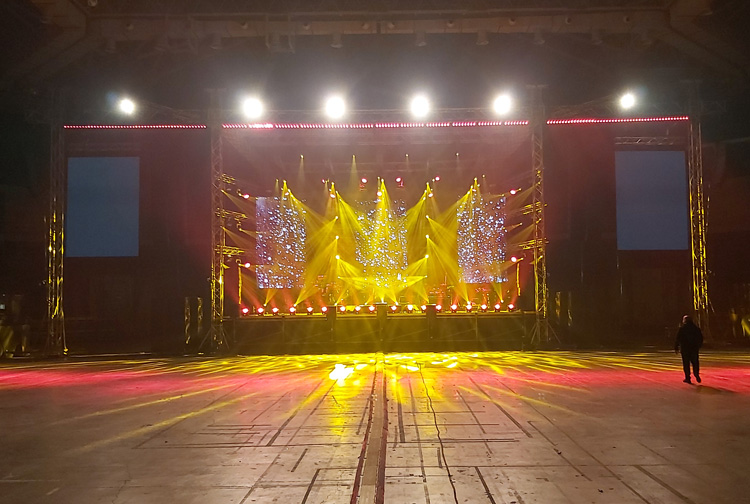
Note that the LEDs are owned by Dimitris Pavlakis Audio-Tech, while the platform is owned by George Megali Seen. The Layher platform was 12.4 x 10.3 meters and included extensions for monitor console and side fills. There were also 400 meters of ELPA railing and 30 meters of Mojo with cable doors.
Periclis Mathiellis told us the following:
The plan came after a discussion with all technicians, the production and of course Mr. Remo, who wanted something impressive that didn't change much during the tour, set up and moved quickly. At first we intended to hang it all over the roof of the stadium, but after a brief study of the tour sites, we realized that many of them had no specification for such setup, so we came up with a support solution.
Mr. Remos had the idea for the three back screens, and his director George Lyras took over the creation of their content and editing it live, with the help of Philippe Trepas on the media server.
Then I designed the screens and created lighting levels for all viewers. In programming, since I returned to Mr. Remo, I follow the same logic that I have in all my jobs. Each song has its own cuelist that can contain from one to 30 cue. At any time I can intervene and change anything that comes to my mind at any point. We have a consciously limited color palette due to repertoire and as in all my work I use color psychology quite a bit. So the symmetry, the rhythm, the illuminating interpretation of the songs, the subconscious play with the emotion of the spectator and the color "harmonies" characterize the aesthetics of this live.
Lighting equipment
49 beam 10r Space lights
16 High End Solaspot 1000
20 Clay Paky B-Eye K-10
24 Clay Paky Sharpy
12 Fos F-5
24 Led Bars Robe Cyc Fx8
6 Blinders
2 MDG 3000
1 MDG atmosphere
1 Grand MA3 full size (operating in mode 2)
2 Followspot Robert Juliat 2500 watt.
8 Lasers by Laserdesign (Θέμης Τσιτσάνης)
4 rgb 20 watt
4 rgb 15 watt
visual equipment
A total of 5 LED screens (3 at the rear and 2 at the front - on each side of the PA system) of a total area of 83 sq.m. by AudioTech's Mr. Dimitris Pavlakis.
the visual equipment was as follows:
3 3x5.5 dimensional rear screens with pitch 4.8, outdoor, 3840hz refresh rate
2 3x5 screens right & left with 3.9 pitch. indoor, 3840hz refresh rate
Media server Resolume 7 with mac book Pro 2019,
Blackmagic Atem image mixer
The screens were driven by a total of 4 Controller Novastar 660 Pro.
ANTONIS REMOS Production Factors - Live Experience Tour 2020
Production
Galaxy Productions - Andris Orphanidou
Assistants - Haris Giannadakis / Maria Touloupi
Sponsor Deluxe soft drinks
Papadimas Audio
Sound
George Giannopoulos
Aris Golias
Makis Alatas
Left Hatiras
Antonis Skourlis
Lights
Chatzigiannis Efthimios
Lupuiyak Serghei
Tsanidis Yuri
Bustiuc Vitalie
Backline / Wireless Tech
Christos Mylonas
Antonis Halil
AudioTech company staff
Barlas Anastasios,
Christina Lagouri
Alexander Benavides
Andreas Mandroukas
Kouskoulis Heracles
Giannis Epifaniou
By Vasilis Ladonikolas, www.alive.gr